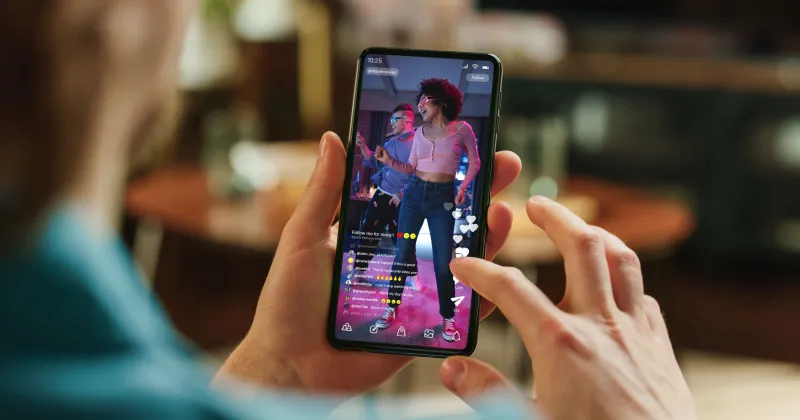
Scroll Trap: The Hidden Science Behind Why You Can't Pick What to Watch

Photo: Wang Jian, CC0, via Wikimedia Commons
You open Netflix. You scroll for twenty minutes. You end up rewatching something you've already seen three times. You close the app. You open it again.
This isn't a personal failure. It's a feature.
The experience of not being able to choose — that low-grade paralysis that settles in after a long day when all you want is something to watch — has been studied, tested, and quietly optimized by some of the most well-funded UX teams in Silicon Valley. What feels like indecision is actually the product of an interface that was specifically designed to keep you in it.
The Architecture of "Almost"
Streaming platforms don't just recommend content. They construct a psychological state — one where you feel perpetually close to finding the perfect thing without ever quite getting there. Former UX designer Marcus Weld, who worked on recommendation interfaces at a major streaming platform before leaving the industry in 2022, described it plainly in a conversation with a tech podcast last year: "The goal was never to get you to a title fast. The goal was to keep you in a state of engaged anticipation as long as possible without triggering frustration."
That window — between interest and irritation — is where the real product lives. Not the show. The scroll.
Every visual element on a streaming homepage is calibrated for this. The autoplay previews that kick in after a second of hovering. The rows that shift based on your recent behavior. The thumbnail art that A/B tests faces versus action shots depending on which version made users click more in your demographic. None of it is accidental. None of it is neutral.
Your Brain on Infinite Choice
Neuroscience has a name for what happens when the brain faces too many options: choice overload. It's been studied since the early 2000s, when psychologists Sheena Iyengar and Mark Lepper ran their famous jam study showing that shoppers were more likely to buy when presented with six options versus twenty-four. But streaming libraries don't offer twenty-four options. They offer thousands.
What modern research has found is that this kind of overwhelming choice doesn't just make decisions harder — it activates the same neural reward pathways that respond to variable reinforcement. The same mechanism behind slot machines. Every new thumbnail is a potential hit. The scroll becomes the gamble.
Dr. Anna Lembke, a Stanford psychiatrist who has written about dopamine and compulsive behavior, has noted in interviews that digital platforms are uniquely positioned to exploit this system because the feedback loop is so compressed. You don't have to wait for a reward. The possibility of a reward is immediate, constant, and just one scroll away.
Streaming services didn't invent this dynamic — but they've refined it into something remarkably smooth.
Friction-Free by Design
One of the most quietly powerful design decisions in modern streaming is the elimination of friction. Autoplay. Seamless profile switching. One-click sign-in across devices. These feel like conveniences, and they are — but they're also barriers removed between you and more consumption.
The concept is sometimes called "zero moment of truth" in UX circles: the idea that every extra step between a user and an action is a chance for them to stop and reconsider. Remove enough steps, and reconsideration disappears with them.
This is especially visible in how streaming platforms handle the post-show moment. Ten years ago, finishing an episode meant the credits rolled and you made a conscious choice to watch another one. Now, the next episode begins counting down before the final scene ends. You have to actively opt out. The default is more.
Weld described this shift as one of the more significant psychological pivots in the industry: "We stopped designing for choice and started designing against pause."
The Recommendation Engine Isn't Recommending to You
Here's the part that tends to surprise people: the algorithm doesn't actually know what you want. It knows what people who behaved like you in the past eventually clicked on. That's a meaningful difference.
Recommendation systems are collaborative filters — they find patterns across millions of users and surface content based on behavioral similarity, not personal taste. Your profile is less a portrait of your preferences and more a cluster assignment. You've been grouped with people who watched the same things at the same times, and the algorithm is serving you what that cluster tends to click.
This creates a feedback loop. The algorithm shows you content similar to what you've already watched. You watch it. The algorithm gets more confident in its cluster assignment. Your recommendations narrow. Over time, the platform's model of you becomes increasingly accurate — but increasingly limited.
Some platforms have experimented with "serendipity scores" — intentionally injecting unfamiliar content to prevent this narrowing. But these features rarely survive long-term, because novelty creates hesitation, and hesitation creates the risk that you close the app.
What the Interface Doesn't Want You to Do
The design of every major streaming platform has one implicit enemy: the moment you decide nothing looks good and put your phone down.
Everything — the layout, the scroll behavior, the thumbnail selection, the autoplay — is oriented against that moment. Not because the platforms are malicious, exactly, but because their business model is measured in watch hours, and watch hours require you to stay.
The uncomfortable truth is that the interface you're navigating was built by people who were very good at their jobs. They understood attention, hesitation, reward, and habit formation. They tested thousands of variations. They found what worked.
And what worked was making the scroll feel like it was about to pay off — always, perpetually, just one more thumbnail away.
Next time you catch yourself twenty minutes deep in a browsing session with nothing picked, remember: that's not a bug. That's the whole point.